
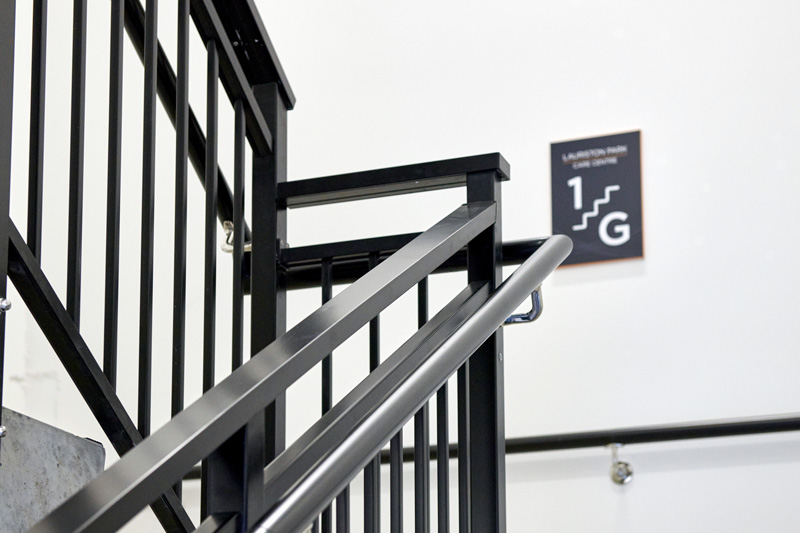
Designing compliant stairways requires more than selecting a balustrade or handrail system. Learn the key New Zealand Building Code requirements for safer, compliant stairway design.
Designing balustrades and handrails for stairways can be challenging because multiple areas of the New Zealand Building Code need to be considered together. Structural performance, accessibility, barrier geometry, and user safety all influence the final design outcome. In many cases, there are also competing design constraints that must be balanced while still achieving compliance.
While balustrades and handrails are often referred to interchangeably, they serve fundamentally different purposes and are subject to different compliance requirements. Understanding these distinctions early in the design process can help architects and specifiers avoid costly redesigns, simplify the consenting process, and achieve safer outcomes for building users.
Download or view the UNEX A Quick Guide to Stairway Balustrades and Handrails for practical diagrams, critical dimensions and key New Zealand Building Code compliance considerations to support project planning and specification.
⬇ Download the guide
(or View the guide at the end of this blog post)
Understanding the Difference Between Balustrades and Handrails
A balustrade is effectively a barrier designed to prevent someone from falling. A handrail, by contrast, is an object that provides support and assistance to a person moving up or down a stairway or ramp.
In some situations, the top rail of a balustrade may also function as a handrail. However, the compliance requirements for each element still need to be considered separately.
Understanding the different functions of these elements is the first step toward achieving a compliant stairway design.
Balustrade Compliance: Strength and Geometry
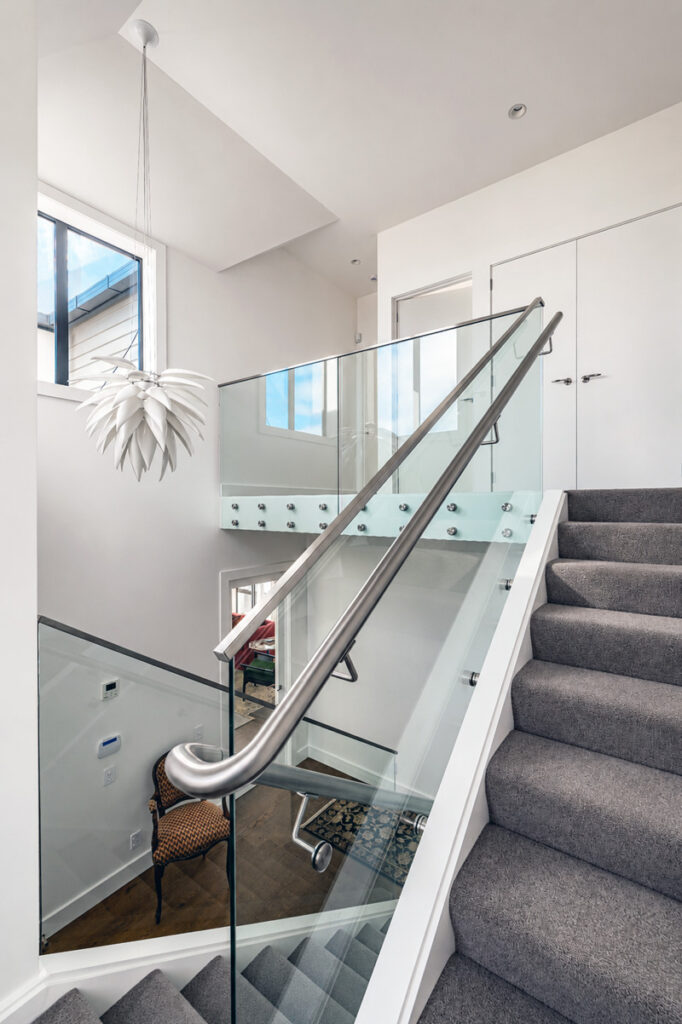
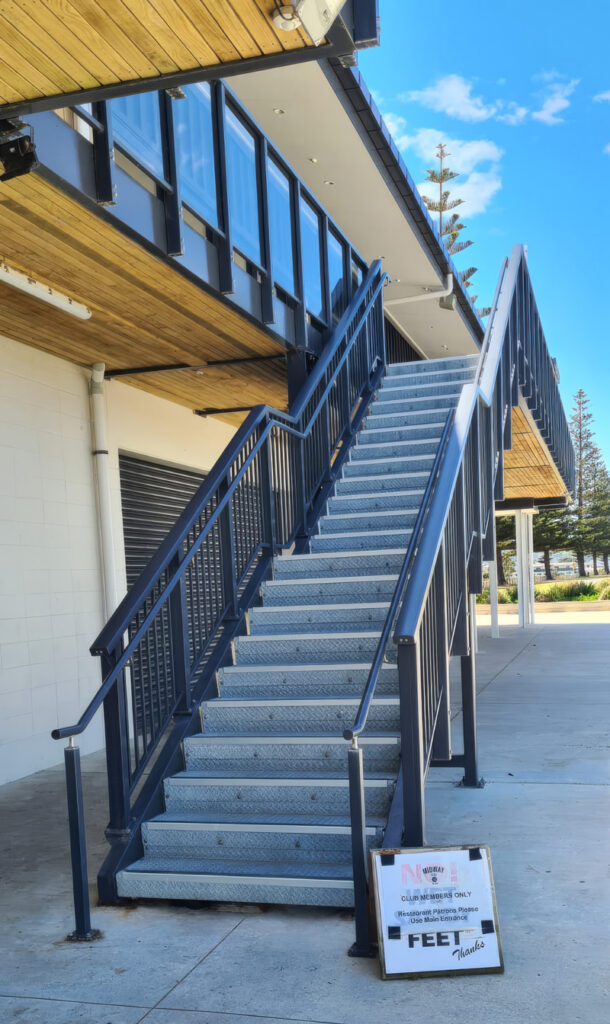
When specifying a balustrade system, there are two primary aspects that must be addressed: strength and geometry.
1. Strength
A balustrade must be capable of resisting the loads imposed by people leaning, pushing, or falling against it. Where glass is incorporated into the design, wind loading may also need to be considered.
Structural compliance is typically assessed under:
- NZ Building Code Clause B1 Structure
- B1/VM1 Verification Method
- AS/NZS 1170.1 Structural Design Actions
Where glass is incorporated into the balustrade, compliance with Clause F2 Hazardous Building Materials must also be considered.
As a general rule, balustrade systems should be reviewed by an appropriately qualified engineer to ensure compliance with the relevant loading requirements. Building Consent Authorities will often require a Producer Statement (PS1) as evidence of compliance.
2. Geometry
Clause F4.2 of the New Zealand Building Code requires buildings to be constructed in a manner that reduces the likelihood of accidental falls. To achieve this, the geometry of the balustrade is critical.
There are three key considerations:
- The minimum height of the balustrade to reduce the likelihood of someone falling over the barrier.
- The maximum allowable openings within the barrier to reduce the likelihood of someone falling through it.
- Requirements that make the barrier difficult for young children to climb.
The final point is particularly important. The Building Code seeks to minimise climbable elements such as projections, ledges, and footholds that could assist a child in climbing over the barrier.
Understanding Stairway Classifications
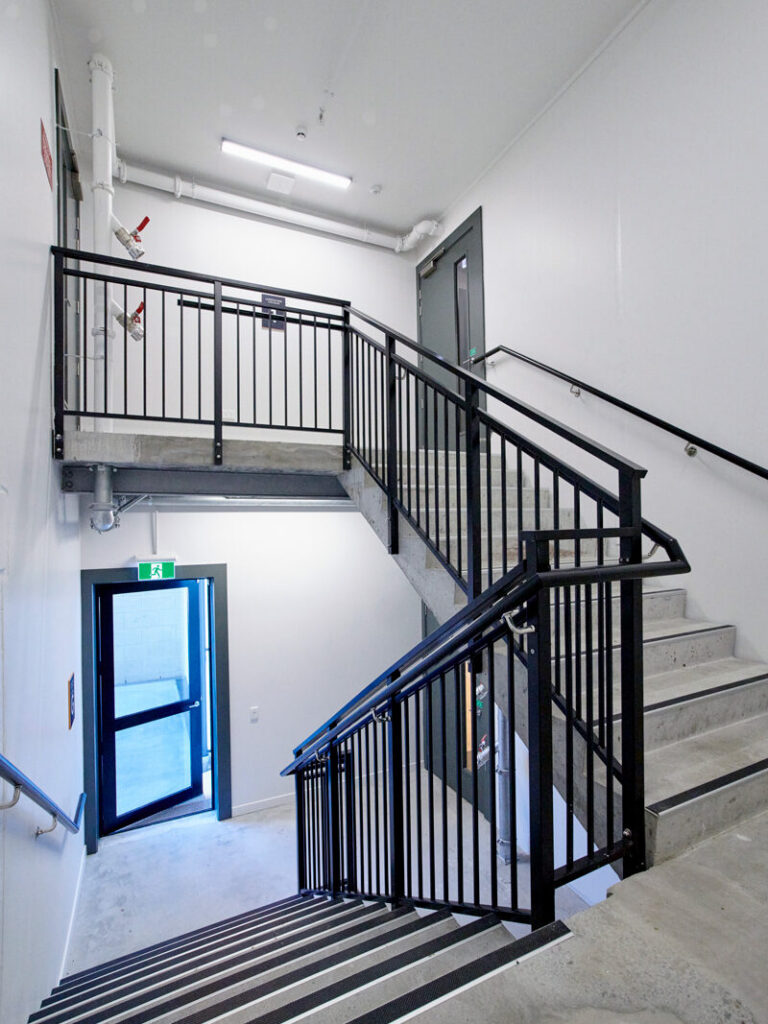
Handrail requirements vary depending on the type of stairway being designed.
- Accessible Stairway
An accessible stairway is a stairway designed for use by people with disabilities. Buildings required to be accessible must provide at least one accessible stairway connected to an accessible route, regardless of whether a lift is also provided. - Common Stairway
A common stairway is one used by the public and is not classified as either a private stairway or an accessible stairway. - Private Stairway
A private stairway is one intended solely for the occupants of a single household unit.
Because accessible stairways are intended for use by people with disabilities, they are subject to more stringent handrail requirements than common or private stairways.
Where Are Handrails Required?
The New Zealand Building Code sets out specific requirements regarding where handrails must be provided.
Some key requirements include:
- All accessible stairways must have handrails on both sides.
- Stairways with two or more risers and a width of 2.0 metres or less must generally have at least one handrail.
- Handrails may be omitted on stairways of two or three risers within or providing access to a household unit.
- Stairways wider than 2.0 metres must have handrails on both sides.
- Stairways wider than 4.0 metres must also include an intermediate handrail located centrally within the stairway.
There are some exceptions to these requirements for certain architectural stair features that are not required to form part of an accessible route.
Why Handrail Profiles Matter
The profile of a handrail is an important compliance consideration because it directly affects how effectively it can be grasped by the user.
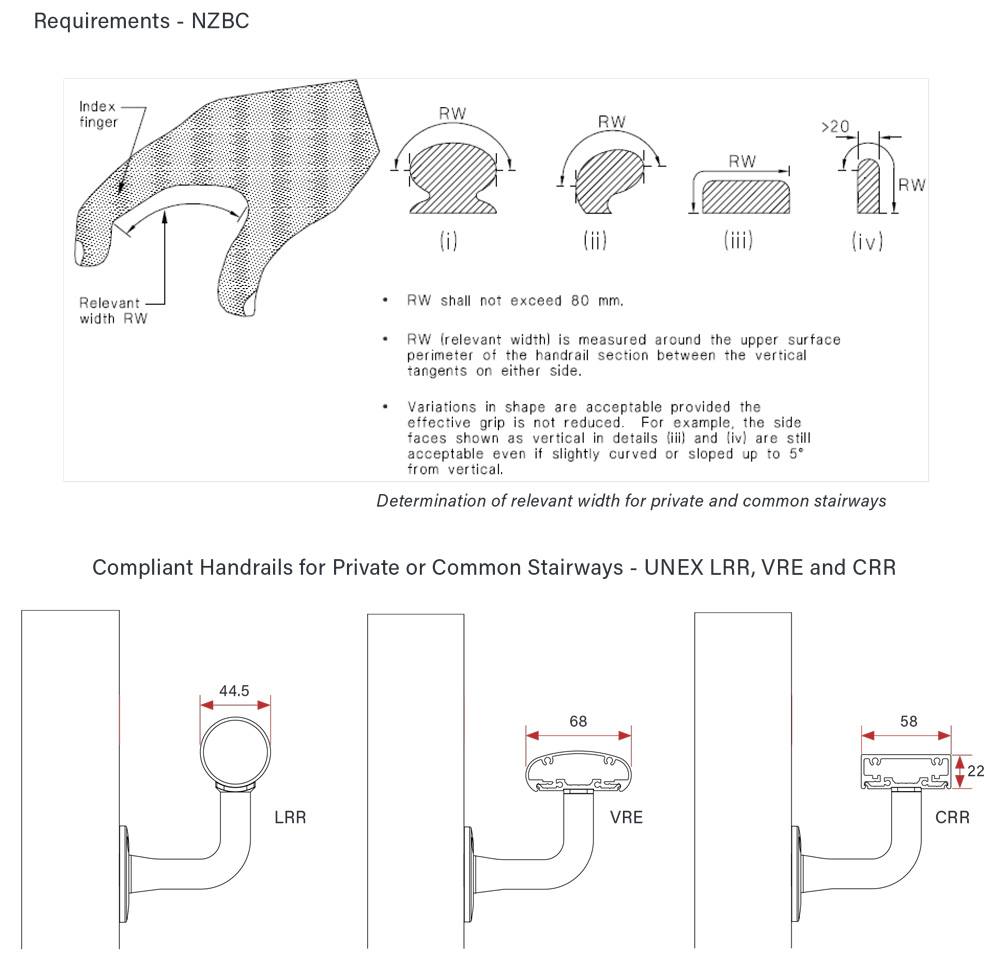
For private and common stairways, D1/AS1 provides guidance on the relevant graspable width of the handrail profile. The relevant width should not exceed 80mm to ensure users can maintain a secure grip.
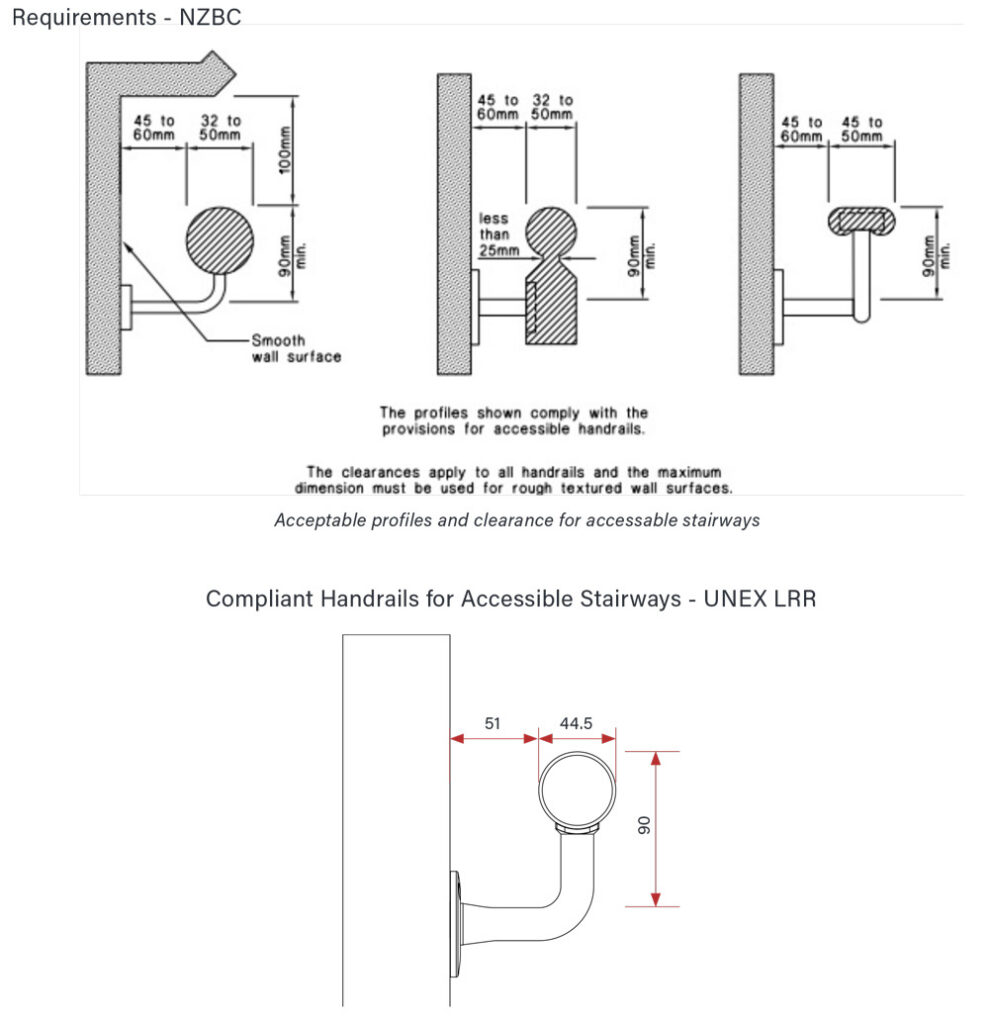
Accessible stairways have more stringent requirements. D1/AS1 illustrates three acceptable handrail profiles and associated clearances. In practice, the most common solution is a circular handrail with a diameter between 32mm and 50mm.
This type of profile provides an effective grip and is often the simplest way to satisfy accessibility requirements.
Selecting a handrail profile based solely on appearance can result in compliance issues, particularly on public buildings and accessible routes.
Critical Stairway Dimensions Every Designer Should Know
Acceptable Solutions D1/AS1 and F4/AS1 contain numerous dimensional requirements.
Some of the most important include:
Accessible Stairway Width
- The clear width between handrails, or between a handrail and a wall, must generally be no less than 900mm.
While no specific minimum width is prescribed for private stairways within household units, a practical minimum width of approximately 850mm is often considered appropriate.
Handrail Extensions
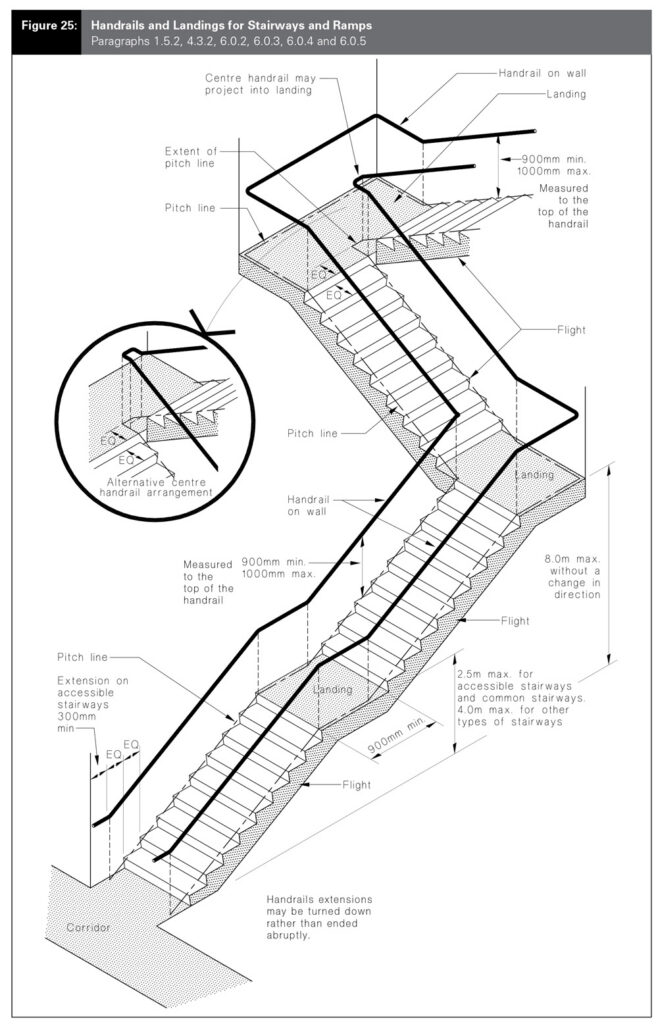
Where a handrail serves an accessible stairway or ramp, a minimum 300mm horizontal extension must be provided at both the top and bottom of the stairway. These extensions assist users when transitioning on and off the stair.
Handrail Height
- Handrails are generally required to be positioned between 900mm and 1000mm above the stair pitch line, measured to the top of the handrail.
- Where the handrail forms part of a stair barrier, it may transition to a height of 1100mm at intermediate landings.
Minimum Barrier Heights
Barrier height requirements vary depending on building type and location.
For detached dwellings and household units:
- Stairs and ramps require a minimum barrier height of 900mm.
- Decks, balconies and mezzanine edges require a minimum barrier height of 1000mm.
For commercial buildings and common areas of multi-unit developments:
- Stairs and ramps require a minimum barrier height of 900mm.
- Most other locations require a minimum barrier height of 1100mm.
Designers should always verify the specific requirements applicable to their project and building classification.
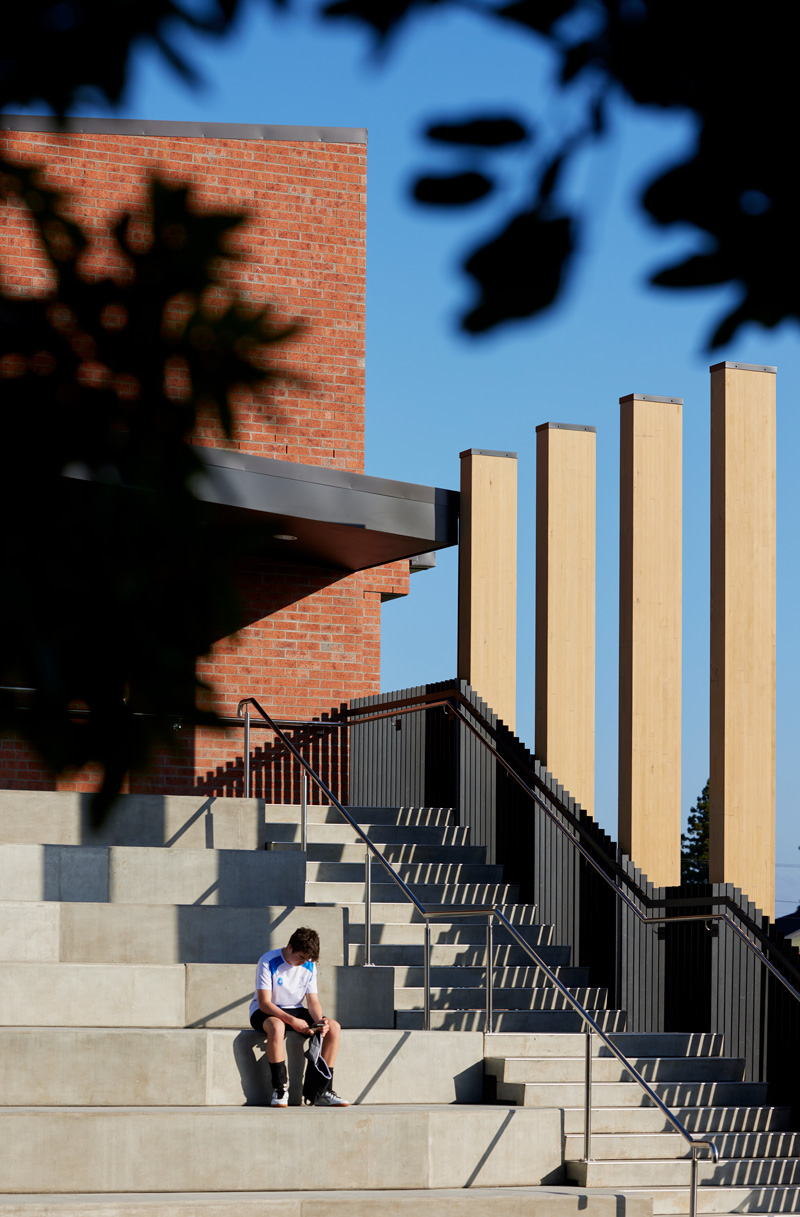
Designing Child-Safe Stairway Balustrades
Additional requirements apply where children under six years of age are likely to be present.
The objective is to reduce the likelihood of children climbing over or passing through a barrier.
Key provisions include:
- Openings within a balustrade should generally prevent the passage of a 100mm diameter sphere.
- The triangular opening between a stair tread, riser and bottom rail should prevent the passage of a 150mm diameter sphere.
- Climbable elements or "toeholds" should be minimised.
- Horizontal rails and ledges that could assist climbing should be carefully considered.
These requirements are particularly relevant in:
- Residential developments
- Schools
- Early childhood education centres
- Public buildings
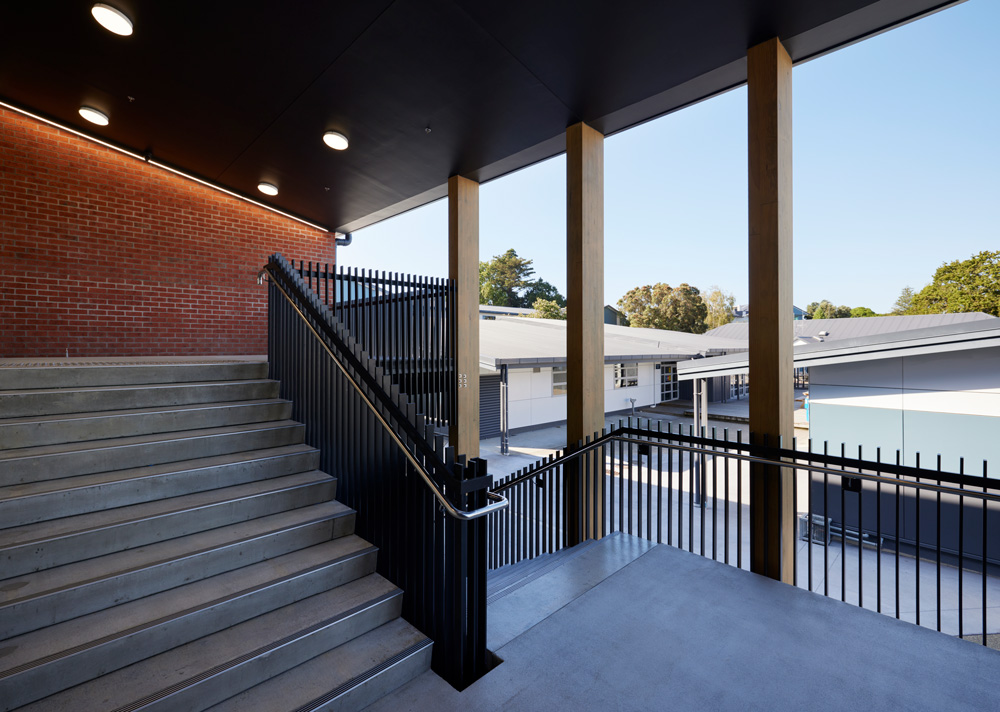
Bringing Compliance Together
Designing compliant stairways requires more than simply selecting a balustrade or handrail system. Structural loading, barrier geometry, accessibility requirements, graspability, clearances and child safety provisions all need to work together to satisfy the New Zealand Building Code.
By considering these requirements early in the design process, architects and specifiers can minimise redesigns, simplify consenting and deliver safer outcomes for building users.
This blog post provides an overview of the key considerations for designing compliant stairway balustrades and handrails. For detailed diagrams, dimensional illustrations and practical examples, explore our complete A Quick Guide to Stairway Balustrades and Handrails below.
If you would prefer a printable version, you can also download the PDF guide.
